
Ryazhenka: The Unique Russian “Baked Milk” Yogurt
While kefir is the sharp, tangy king of fermented dairy in Eastern Europe, Ryazhenka is its gentler, caramel-flavored cousin. Often considered a childhood treat, this traditional fermented “baked milk” has a unique history and taste profile.
What is Ryazhenka?
Dairy products are a cornerstone of Russian and Ukrainian cuisine. While kefir is known for its sharp bite and distinct culture, Ryazhenka (Ряженка) is famously mild, creamy, and possesses a unique savory-sweet flavor. It was traditionally seen as a treat for children, often mixed with a spoonful of sugar, due to its less acidic nature compared to kefir.
The “Baked Milk” Difference
The defining characteristic of Ryazhenka is its color and flavor. Unlike pure white kefir or yogurt, Ryazhenka has a distinct tan or light brown tint and a subtle caramel taste.
This comes from a long, slow cooking process before fermentation. The milk is heated for hours, causing a **Maillard reaction**—a chemical reaction between amino acids and sugars that browns the milk and creates complex flavor compounds, similar to caramelization.
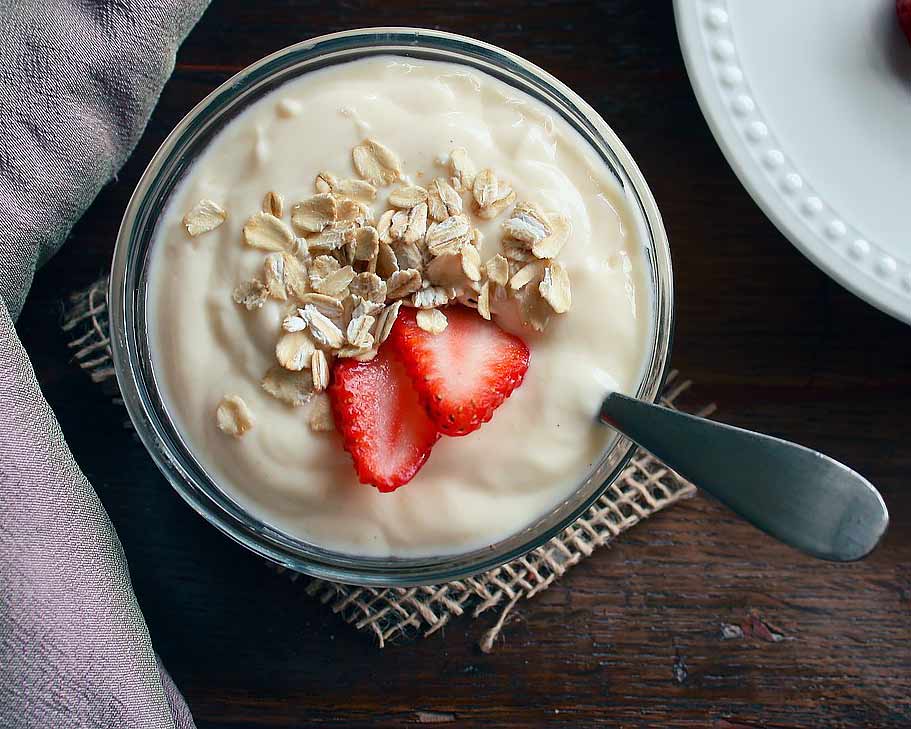
Note the distinctive creamy-tan color of Ryazhenka compared to white milk.
How is Ryazhenka Made? (Traditional vs. Modern)
The process involves two main stages: long heating followed by thermophilic fermentation.
1. The Long Bake (Glechik in the Oven)
Historically, milk was placed in a clay pot called a glechik and put into a traditional Russian brick oven for an entire day on low heat. Modern methods involve simmering pasteurized milk on very low heat for 8 hours or more.
During this time, water evaporates, thickening the consistency. A brown crust often forms on top, and the milk develops its characteristic color and flavor. Because of this scalding process, the resulting milk is practically sterile.
2. The Fermentation
Once cooled to about 40°C (104°F), the culture is added. In households, a dollop of sour cream (smetana) was traditionally used to trigger fermentation. Modern industrial production uses pure thermophilic bacterial cultures (similar to yogurt).
The mixture is kept warm (around 38°C – 40°C) for 3 to 6 hours until set. Industrially made Ryazhenka typically has a fat content of 3.5–4% and a protein content of at least 3%.
Comparison: Ryazhenka vs. Kefir
While both are healthy, probiotic-rich fermented milk drinks, they are quite different.
🏺 Ryazhenka
- Base: “Baked” (long-simmered) milk.
- Flavor: Mild, creamy, savory-sweet, caramelized hue.
- Fermentation: Thermophilic (needs heat, like yogurt).
- Culture: Typically bacterial only (e.g., using sour cream or yogurt culture).
🥛 Milk Kefir
- Base: Regular fresh or pasteurized milk.
- Flavor: Sharp, tart, slightly yeasty and effervescent (fizzy). Pure white.
- Fermentation: Mesophilic (room temperature).
- Culture: A complex symbiotic SCOBY of bacteria AND yeasts (kefir grains).
Conclusion: Ryazhenka offers a smoother, uniquely caramelized flavor due to its processing, while kefir provides a sharper taste and generally greater probiotic diversity due to the complex nature of kefir grains.