
Making Milk Kefir is not just a recipe; it’s a balancing act. Too many grains? It ferments in seconds. Too much milk? It spoils before it sets. Too hot? It separates into cheese.
To get consistent, creamy kefir, you need to master The Golden Ratio. This guide breaks down the math of fermentation so you can predict exactly when your brew will be ready.
📚 Essential Kefir Data
⚖️ The “Golden Ratio” Rule
Before we look at the complex charts, memorize this simple starting point. This is the standard ratio for a 24-hour ferment at a standard room temperature (22°C).
- The Metric Ratio: 1 part grains to 15 parts milk (1:15).
- The Kitchen Ratio: 1 Tablespoon grains per 1 Cup (250ml) milk.
- Why it works: This ensures the bacteria have enough food (lactose) to survive, but not so much that they can’t acidify the milk quickly enough to prevent spoilage.
15g
(1 Tbsp Grains)
⬇
250ml
(1 Cup Milk)
📊 The Ultimate Fermentation Chart
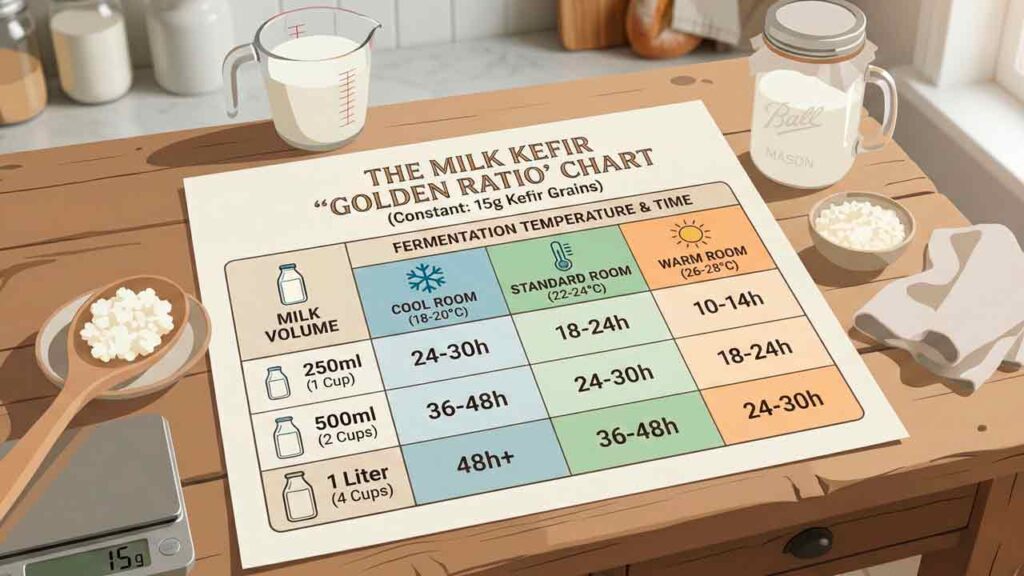
Use this table to estimate your timing based on 15g (1 Tablespoon) of grains.
| Milk Volume | Cool Room (18°C – 20°C) | Standard Room (22°C – 24°C) | Warm Room (26°C – 28°C) |
|---|---|---|---|
| 250ml (1 Cup) Strong, thick kefir | 24 – 30 Hours Slow ferment. Very creamy. | 18 – 24 Hours Standard timing. | 10 – 14 Hours Fast! Watch closely for separation. |
| 500ml (2 Cups) Standard batch | 36 – 48 Hours Risk of yeast taste increasing. | 24 – 30 Hours Good daily cycle. | 18 – 24 Hours Ideal for summer. |
| 1 Liter (4 Cups) Family size | 48+ Hours Too slow. Milk may spoil. | 36 – 48 Hours Stir every 12h to help grains eat. | 24 – 30 Hours Great for hot climates. |
🚀 PRO TIP: The “Catch-Up” Method
Did your grains grow? Are you now fermenting too fast?
The Problem:
Kefir grains grow by 10-20% every week. If you start with 15g, in two weeks you might have 25g. Suddenly, your 24-hour kefir is separating in 12 hours.
The Solution:
Every Sunday, weigh your grains or measure them in a spoon.
1. Eat the extra: They are pure probiotics.
2. Freeze the extra: Build a backup supply.
3. Increase Milk: Switch from 250ml to 500ml per batch.
🌡️ The Hidden Variable: Temperature
The ratio isn’t just Grains vs. Milk. Temperature acts as a gas pedal.
- Summer (25°C+): The metabolism of the grains speeds up drastically. You must either reduce grains or increase milk to keep a 24-hour cycle.
- Winter (18°C-): The grains slow down (hibernate). You might need to use less milk (e.g., 200ml for 15g grains) to get it to set within a day.
How to tell it’s done?
Forget the time. Forget the ratio. Look at the jar.
- ✅ Milk has thickened (like yogurt).
- ✅ Small bubbles are visible in the curd.
- ✅ Small “Pockets of Whey” (clear liquid) appear at the bottom.
If you see huge separation (half whey, half curd), you waited too long!
❓ Ratio FAQs
Can I use 1 grain in 1 liter of milk?
Technically yes, but it’s risky. One grain will eventually ferment a liter, but it might take 4 days. During that time, the milk is sitting at room temperature unfermented, which invites bad bacteria and spoilage. Stick to the 1:15 or 1:30 ratio range.
My grains are tiny. Does size matter?
Surface area matters. 15g of many tiny grains ferments faster than one giant 15g grain. Why? More surface area touches the milk. If you have tiny grains, check your kefir sooner.
I want to make less kefir. Can I use less grains?
Yes. You can ferment just 1/2 cup (125ml) of milk, but you should reduce your grains to roughly 1 teaspoon (approx 5-7g).
What happens if I use too many grains?
This leads to Separation Anxiety. The milk turns to curds and whey extremely fast, often creating a very sour, gritty drink.
How do I measure grains without a scale?
1 Tablespoon of drained grains is roughly 15 grams. It doesn’t have to be perfect! Fermentation is an art, not exact science.
Does the type of milk change the ratio?
Yes. Raw milk often ferments faster because it has its own natural bacteria. Coconut milk ferments very fast (often in 12 hours) due to different sugar structures.